
A well-planned email marketing for events strategy can help you reach the right audience and increase registrations.
Introduction
Promoting an event successfully requires more than simply announcing the date, venue, and registration link. Whether you are organizing a business conference, webinar, workshop, product launch, networking event, exhibition, or local gathering, reaching the right audience at the right time can make a major difference. This is where email marketing for events becomes a powerful promotional strategy. If you are wondering how to use email marketing effectively to promote events, the key is to create useful, timely, and personalized communication instead of sending the same promotional email to everyone. A well-planned event email marketing strategy can help you generate awareness, increase registrations, keep attendees engaged, and build relationships even after the event ends. In this guide, we will explain how to create an effective email marketing strategy for event promotion, what types of emails you should send, how to improve open and click-through rates, and how to measure your campaign performance
Why Email Marketing Is Important for Event Promotion
Email remains one of the most direct ways to communicate with potential attendees. Unlike social media posts that can easily disappear from a user’s feed, emails can reach people directly in their inbox.
A strong email marketing for events campaign can help you:
Create awareness about your upcoming event
• Drive registrations and ticket sales
• Share important event information
• Build excitement before the event
• Remind registered attendees about the event
• Encourage attendees to participate
• Collect feedback after the event
• Promote future events
1.Email Marketing for Events: Build a Targeted Email List
The first step in learning how to use email marketing effectively to promote events is building the right audience.
A large email list is not always better. What matters is whether the people on your list are genuinely interested in your event. You can collect subscribers through:
Website registration forms
• Previous event attendees
• Newsletter subscriptions
• Social media campaigns
• Landing pages
• Free webinars or downloadable resources
• Existing customer databases
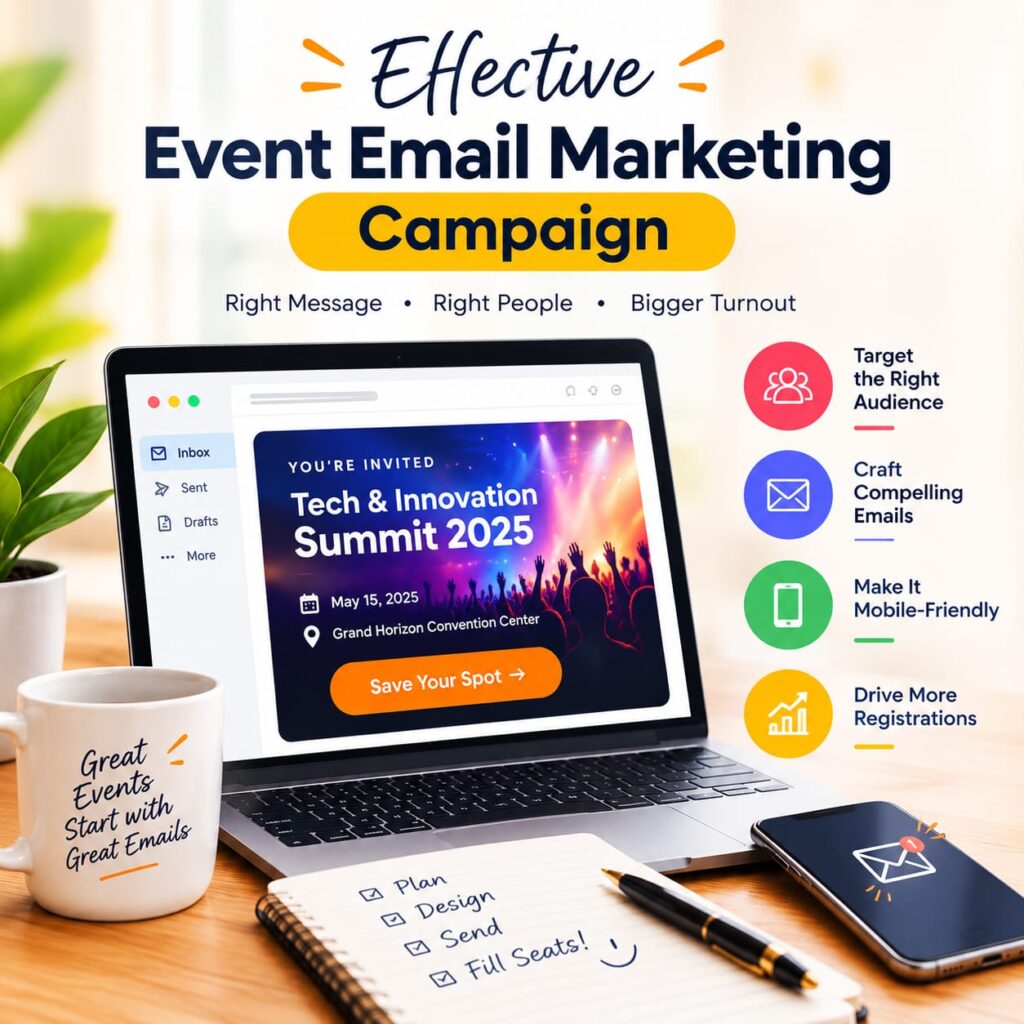
2.Create an Effective Event Email Marketing Campaign
A simple campaign could include:
• Email 1 – Event Announcement: Introduce the event, explain its main benefits, and provide the registration link.
• Email 2 – Value-Focused Email: Explain what attendees will learn, experience, or gain from attending.
• Email 3 – Speaker or Agenda Highlight: Introduce important speakers, sessions, activities, or event highlights.
• Email 4 – Urgency Email: Use a genuine deadline such as “Early-bird registration ends Friday.”
• Email 5 – Final Reminder: Remind registered and interested users that the event is approaching.
3.Write Attention-Grabbing Subject Lines
Your subject line is one of the first things people see. Even a well-designed email will not perform well if people do not open it.
When creating email campaigns to promote events, keep subject lines clear, relevant, and interesting.
• “Your Invitation to Our Upcoming Business Summit”
• “Join Industry Leaders at Our Next Event”
• “Early-Bird Registration Ends Soon”
• “5 Reasons You Should Attend Our Upcoming Workshop”
• “Only 3 Days Left to Register”
4.Personalize Your Event Emails
Instead of sending one generic email to your entire database, use segmentation to deliver different messages to different groups.
This approach can make your email marketing strategy for event promotion more targeted and effective.
New subscribers: Introduction to the event
• Previous attendees: Special invitation
• Registered attendees: Event preparation information
• Unregistered leads: Benefits and registration reminders
• VIP customers: Exclusive access or offers
5.Focus on the Benefits of Attending
One common mistake in event promotion is focusing too much on event details. Instead of simply saying “Join our event on August 25 at 10 AM,” explain why people should care. When you clearly communicate the benefits, your audience has a stronger reason to register. Your event emails should answer three simple questions: What is the event? Why should I attend? What should I do next?
6.Use Strong Calls-to-Action
A good email marketing for events campaign should make the next step obvious. Instead of placing multiple competing links throughout the email, use a clear primary CTA such as Register Now, Book Your Seat, Get Your Ticket, or Reserve Your Spot. Make sure the CTA takes users directly to a simple registration or ticketing page. The fewer unnecessary steps users have to take, the easier it becomes for them to complete registration.
7.Send Reminder Emails at the Right Time
Event reminders are an important part of promoting events with email marketing. People may register weeks or months before an event and forget about it. Timely reminders keep your event fresh in their minds.
However, avoid overwhelming your audience with too many emails. Reminder emails can include the date, time, location, joining link, parking information, agenda, speaker details, or anything attendees need to know.
7 days before the event
• 3 days before the event
• 1 day before the event
• A few hours before the event
8.Optimize Emails for Mobile Devices
Many people check their emails on smartphones. Therefore, mobile optimization should be an essential part of your event email marketing strategy.
Your registration button should be easy to tap on a mobile screen. Before sending your campaign, test the email on different screen sizes and email clients.
Responsive design
• Easy-to-read fonts
• Short paragraphs
• Clear headings
• Properly sized buttons
• Fast-loading images
• Simple navigation
9.Create a Post-Event Email Campaign
Your email marketing campaign should not stop when the event ends. A post-event email can help you maintain the relationship with attendees. You can send: This makes email marketing more than just an event promotion tool. It becomes a long-term relationship-building channel.
Thank-you emails
• Event photos or videos
• Presentation slides
• Recording links
• Feedback surveys
• Certificates
• Special offers
• Information about upcoming events
10.Track Your Email Marketing Performance
Knowing how to use email marketing effectively to promote events also means understanding what is working and what needs improvement. Important metrics include: You can test different subject lines, CTAs, email designs, sending times, and content to improve campaign performance.
Open Rate: Shows how many recipients opened your email.
• Click-Through Rate: Measures how many people clicked your links.
• Conversion Rate: Shows how many users completed registration or another desired action.
• Unsubscribe Rate: Helps identify whether your content is too frequent or irrelevant.
• Registration Rate: Measures how effectively your emails generate event registrations.
Conclusion
With the right email marketing for events strategy, businesses can improve engagement and drive more event registrations.
Understanding how to use email marketing effectively to promote events can help businesses and event organizers attract more attendees, improve registrations, and maintain stronger relationships with their audience. The most successful campaigns focus on the entire attendee journey—from the first announcement to registration, reminders, event participation, and post-event follow-up. Instead of sending random promotional emails, create a structured event email marketing campaign with relevant content, clear CTAs, audience segmentation, personalization, and timely communication. When combined with proper tracking and continuous optimization, email marketing for events can become oneof the most reliable ways to promote events and generate meaningful results.
Conclusion
1.Why is email marketing effective for event promotion?
Email marketing helps you reach your target audience directly, build awareness, share event details, and encourage registrations or ticket purchases.
2.When should I start email marketing for an event?
Ideally, start 3–6 weeks before the event. Send follow-up emails closer to the event to create urgency and remind registered attendees.
3.What should an event promotional email include?
Include a compelling subject line, event name, date and venue, key benefits, important highlights, and a clear Call-to-Action (CTA) such as “Register Now” or “Get Your Tickets.
4.How can I increase event email open rates?
Use short and engaging subject lines, personalize emails, segment your audience, and send emails at times when your audience is most likely to check their inbox.
5.How can I measure the success of an event email campaign?
Track metrics such as open rate, click-through rate, registration rate, conversion rate, and unsubscribe rate to understand campaign performance and optimize future emails.