
Introduction
Search is changing rapidly. For years, businesses focused primarily on traditional SEO to improve rankings on search engines and attract organic traffic. However, the rise of AI-powered platforms such as generative search engines is changing how users discover information, products, and services. This shift has created a growing need for Generative Engine Optimization, commonly known as GEO.
Unlike traditional SEO, which focuses heavily on ranking web pages in search results, GEO focuses on making content useful, understandable, authoritative, and easy for AI systems to identify and reference. This does not mean SEO is becoming irrelevant. Instead, businesses need to understand how GEO SEO, AI SEO, and traditional SEO can work together.
This article presents a practical 6-step framework for moving from SEO to a GEO model. It also explains how to optimize for AI search, create content that performs well in generative search, and build a stronger long-term digital visibility strategy.
What Is Generative Engine Optimization?
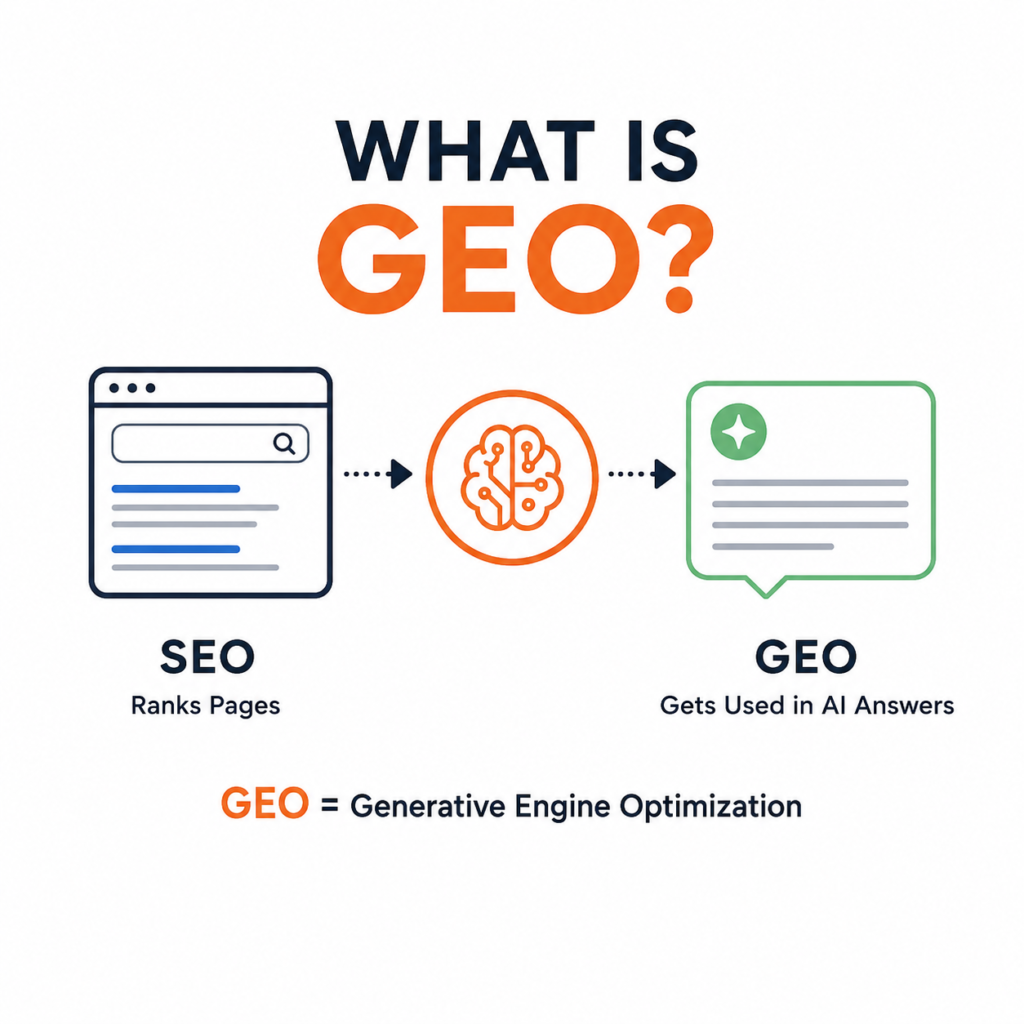
Generative Engine Optimization is the process of optimizing digital content so that AI-powered search and answer engines can understand, process, and potentially use that information when generating responses.
Traditional search engines generally provide a list of links. AI-powered search experiences can instead summarize information and provide direct answers to users.
This makes generative search optimization increasingly important for businesses that want their expertise and content to appear within AI-generated answers.
A successful GEO approach focuses on:
- Creating accurate and valuable content.
- Demonstrating expertise and authority.
- Structuring information clearly.
- Answering specific user questions.
- Providing trustworthy information and supporting evidence.
- Making content easy for search engines and AI systems to understand.
Therefore, Generative Engine Optimization should be viewed as an extension of modern search optimization rather than a complete replacement for SEO.
- Create Content That Answers Real Questions
Focus on clear, useful answers to the questions your target audience is actually searching for. - Build Strong Brand Authority
Publish expert-driven content, original insights, case studies, and reliable information that establishes your brand as a trusted source. - Optimize Content for AI Understanding
Use clear headings, concise explanations, structured information, FAQs, and relevant context so AI systems can easily understand your content. - Focus on Topics, Not Just Keywords
Build comprehensive content around important topics instead of targeting individual keywords in isolation. Cover related questions and user intent naturally. - Combine SEO with GEO Strategies
Keep your technical SEO foundation strong while adapting your content for AI-powered search, helping your brand stay visible across both traditional and generative search experiences.
SEO vs GEO: Why Businesses Need Both
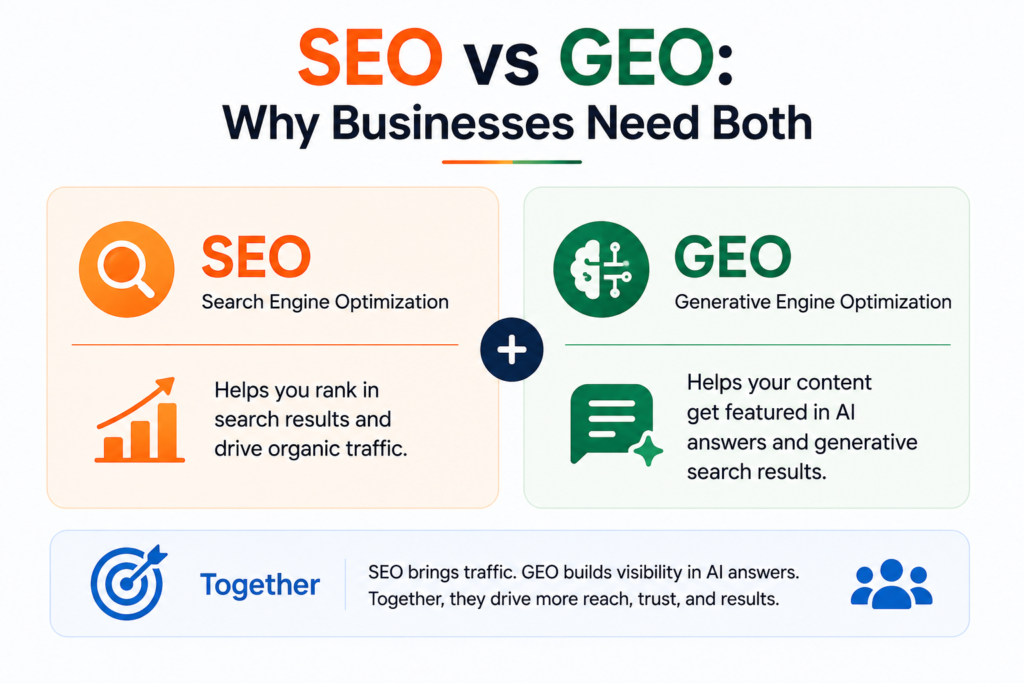
It is important to understand that GEO does not make traditional SEO unnecessary.
SEO continues to provide the foundation for website discoverability, while GEO expands that strategy into AI-powered search experiences.
A modern approach can combine:
- SEO for traditional organic search visibility.
- GEO SEO for generative search visibility.
- AI SEO for AI-driven discovery.
- AI search optimization for conversational search experiences.
- Generative search optimization for AI-generated answers.
Together, these approaches create a more comprehensive search strategy.
Businesses that focus exclusively on traditional rankings may miss opportunities as users increasingly interact with AI-powered search tools. At the same time, businesses that completely ignore SEO may lose valuable visibility in conventional search results.
The better approach is to integrate both.
Practical GEO Strategy Checklist
If you are beginning your transition from SEO to GEO, use the following checklist:
- Audit your existing SEO strategy and identify areas that can support GEO.
- Research conversational queries used by your target audience.
- Create comprehensive topic-based content rather than isolated keyword pages.
- Answer questions directly using clear and concise explanations.
- Improve content structure with headings, lists, tables, and logical sections.
- Demonstrate expertise and authority through original insights and credible sources.
- Update outdated content regularly.
- Build high-quality backlinks and brand mentions.
- Optimize for AI search without compromising human readability.
- Track organic and AI-related visibility as search technology evolves.
How to Optimize for AI Search: Key Principles
If your primary objective is how to optimize for AI search, focus on the following principles:
1. Answer specific questions
Create content that directly answers the questions your audience is asking.
2. Provide complete context
Do not provide isolated definitions. Explain concepts, examples, benefits, limitations, and practical applications.
3. Use clear content structures
Headings, subheadings, lists, FAQs, and concise paragraphs make information easier to understand.
4. Demonstrate expertise
Use original research, real examples, case studies, expert opinions, and credible references.
5. Keep information accurate
Regularly review and update content to prevent outdated information from reducing trust.
6. Focus on user intent
The objective of AI search optimization should be satisfying the user’s information need rather than simply inserting keywords into an article.
The Future of GEO and SEO
The future of search will likely involve a combination of traditional search engines, AI-generated answers, conversational interfaces, and other discovery platforms.
This means businesses need to think beyond rankings and clicks. They should focus on becoming a reliable source of information that users and AI systems can understand.
Generative Engine Optimization is therefore becoming an important part of modern digital marketing.
Companies that invest early in GEO strategy, AI SEO, and generative search optimization can build a stronger foundation for the changing search landscape.
The key is not to abandon SEO. Instead, businesses should evolve their existing SEO processes and combine them with GEO principles.
Conclusion
Moving from traditional SEO to a GEO model is not about completely replacing what already works. It is about adapting your search strategy to the way people increasingly discover information through AI-powered platforms.
The six-step framework provides a practical starting point: understand the shift, research user questions, build topic-focused content, create AI-friendly information, strengthen authority, and continuously measure performance.
By combining SEO with GEO SEO, AI search optimization, and AI SEO, businesses can create content that is valuable for users while improving their chances of being discovered across traditional and generative search experiences.
Ultimately, learning how to improve AI search visibility will become an increasingly important part of digital marketing. Businesses that start adapting their content strategy now will be better positioned for the next generation of search.
FAQS
1. What is Generative Engine Optimization?
Generative Engine Optimization is the practice of optimizing content so AI-powered search and answer engines can better understand, interpret, and potentially reference the information when generating responses.
2.What is the difference between SEO and GEO?
SEO primarily focuses on improving visibility in traditional search engine results, while GEO focuses on improving the visibility and usefulness of content within AI-generated search experiences. A modern strategy can use both.
3.How does generative engine optimization work?
How does generative engine optimization work? It works by improving content quality, structure, relevance, authority, and contextual clarity so AI systems can more easily understand and use the information when responding to relevant queries.
4.How can I optimize my website for AI search?
If you are wondering how to optimize for AI search, start by creating authoritative, well-structured, accurate, and comprehensive content that directly answers your audience’s questions. Use clear headings, relevant entities, supporting evidence, FAQs, and conversational language.
5.Is GEO replacing traditional SEO?
No. GEO SEO should generally complement traditional SEO rather than replace it. SEO remains important for conventional search visibility, while GEO helps businesses adapt to AI-powered search and answer experiences.