
Introduction
SEO is no longer just about adding keywords to web pages and waiting for search engines to rank your content. Businesses need a broader digital marketing strategy that attracts the right audience, promotes valuable content, and builds long-term relationships with website visitors.
So, how email marketing can improve SEO is an important question for businesses looking to connect their content marketing and SEO efforts. While email marketing does not directly improve Google rankings, it can help increase content visibility, drive qualified visitors to your website, encourage content sharing, and create opportunities for mentions and backlinks.
When SEO and email marketing are used together, businesses can create a stronger content distribution system. SEO can help identify what people are searching for, while email can distribute that content to an audience that has already shown interest.
In this blog, we’ll explore five practical email marketing hacks for SEO and explain how to use email marketing for SEO to get more value from your existing content.

1. Promote Your Best Content Through Email
Creating high-quality SEO content takes time and effort, but publishing an article doesn’t guarantee that people will immediately find it. Even well-optimized content can take time to gain visibility through organic search.
Email marketing gives you a direct way to introduce your content to people who are already familiar with your brand. Instead of waiting for search traffic to grow, you can use your subscriber list to give your newest and most valuable content an initial push.
For example, if you’ve published a detailed guide about digital marketing, your newsletter can introduce the main problem, share one useful insight from the guide, and then direct readers to the complete article.
3 Key Points
1. Promote valuable content
Focus your emails on blogs, guides, case studies, research, and other resources that genuinely help your audience. Valuable content is more likely to attract attention and encourage readers to visit your website.
2. Use a strong call-to-action
Your email should make it clear what you want the reader to do next. A CTA such as “Read the Complete Guide” or “Explore the Full Report” gives subscribers an obvious next step.
3. Target the right subscribers
Don’t send every piece of content to your entire database. Promote content to subscribers whose interests match the topic. This makes your campaign more relevant and increases the possibility of meaningful engagement.
Why It Helps SEO
Email doesn’t directly increase search rankings, but it can increase the visibility and reach of your content. When more relevant people discover useful content, there may be more opportunities for sharing, mentions, and backlinks.
This is one of the practical SEO benefits of email marketing because email can help your best resources reach an audience that may otherwise never discover them.
Pro Tip: Treat email as a way to amplify your best SEO content rather than simply sending promotional messages.
2. Use Email to Increase Relevant Website Traffic
Website traffic is an important part of building a strong digital presence, but not all traffic has the same value. Getting hundreds of random visitors isn’t necessarily better than getting a smaller number of people who are genuinely interested in your content or services.
Email marketing allows you to bring people from your existing audience directly to relevant pages on your website. A well-planned email can guide subscribers from an interesting topic to a detailed blog, guide, landing page, or other resource.
For example, if your email discusses ways to improve SEO, linking directly to an in-depth SEO guide gives readers a natural next step instead of sending them to a generic homepage.
3 Key Points
1. Link to relevant pages
Make sure the destination page matches the subject of your email. When readers click on a link and immediately find useful information, the overall experience becomes more valuable.
2. Focus on qualified traffic
Don’t measure success only by the number of clicks. The goal should be to attract visitors who are genuinely interested in the topic and more likely to engage with your website.
3. Create clear CTAs
Use simple and specific CTAs that tell readers what they will get after clicking. Clear CTAs can make it easier for subscribers to move from your email to your website.
Why It Matters
Using email to drive relevant visitors creates a stronger connection between email marketing and organic traffic. Instead of relying entirely on search engines to bring people to your website, you can use your existing audience to distribute useful content directly.
This approach can also help businesses increase website traffic with email marketing by consistently directing subscribers toward relevant blogs, guides, landing pages, and other resources.
Pro Tip: Always make sure the landing page delivers exactly what the email promises.
3. Repurpose SEO Content Into Email Campaigns
Creating fresh content consistently can be challenging. Instead of treating every blog post as a one-time publication, businesses can repurpose existing SEO content into multiple email campaigns.
This approach allows you to extend the lifespan of your content while reaching your audience in different formats. A detailed blog can provide enough information for several newsletters, educational emails, or short campaigns.
For example, an article about improving website traffic could become a newsletter featuring three important tips, followed by another email explaining common traffic mistakes and a final email directing readers to the complete guide.
3 Key Points
1. Turn blogs into newsletters
Take the most useful ideas from an existing article and turn them into a short, engaging email. Give readers enough value to make the email useful while encouraging them to explore the full article.
2. Create email series from long-form content
A detailed guide can often be divided into several smaller topics. Instead of explaining everything in one email, create a short series that gradually introduces different ideas.
3. Use SEO research for email ideas
Keywords, search queries, FAQs, and audience pain points can provide excellent ideas for email campaigns. This creates a stronger connection between SEO and your email marketing content strategy.
Why It Works
Repurposing content saves time and allows businesses to get more value from the research and effort already invested in creating content.
It also creates more opportunities to distribute important resources. A single SEO article can continue generating value through newsletters, educational emails, and targeted campaigns long after its original publication.
Pro Tip: Don’t copy an entire blog into an email. Summarize the most useful points and give readers a reason to visit the original content.
4. Encourage Content Sharing and Backlink Opportunities
One of the useful SEO benefits of email marketing is that it can help your content reach people who have the ability to amplify it.
When you create original research, statistics, expert insights, or valuable industry resources, you can use targeted email campaigns to introduce that content to journalists, industry professionals, creators, partners, and relevant subscribers.
If these people find the content useful, they may share it with their audience or reference it in their own articles. This can create opportunities for additional exposure, mentions, and backlinks.
3 Key Points
1. Promote original and valuable resources
Research reports, statistics, original studies, expert opinions, and detailed guides are more likely to attract attention because they provide information that others may find useful.
2. Reach people who can amplify your content
Think beyond your general subscriber list. Relevant journalists, industry experts, creators, partners, and professionals can help your content reach a wider audience.
3. Personalize your outreach
Avoid sending the exact same message to everyone. Explain why the resource is relevant to the person you’re contacting and make the value of the content clear.
Why It Helps
Email itself isn’t a backlink-building shortcut. Its value comes from helping your content reach people who may naturally choose to reference or share it.
The more useful and relevant your content is, the greater the potential for it to be discovered and amplified by others.
This is an important part of understanding how email marketing can improve SEO without treating email as a direct Google ranking factor.
Pro Tip: Focus on creating something worth sharing before focusing on asking people to share it.
5. Segment Your Audience for Better Engagement
Sending the same email to every subscriber can make your campaigns less effective. Different people have different interests, needs, and levels of familiarity with your business.
Audience segmentation allows you to divide your subscribers into smaller groups and send each group content that is more relevant to them.
For example, someone who regularly reads your SEO articles may be more interested in an advanced SEO guide, while another subscriber who engages with your social media content may prefer social media marketing tips.
3 Key Points
1. Segment based on interests
Create groups according to the topics subscribers are interested in, such as SEO, social media, content marketing, or email marketing.
2. Use behavior to improve targeting
Website activity, previous email clicks, and content engagement can help you understand what individual subscribers are interested in.
3. Use engagement insights for content planning
Your email performance can reveal which subjects attract attention. Use these insights to identify topics that may deserve more detailed blogs, guides, or other SEO content.
Why It Supports SEO
Segmentation helps businesses understand their audience more effectively. When you know which topics people respond to, you can make better decisions about future content creation and distribution.
Email engagement metrics aren’t direct Google ranking factors, but they can provide useful audience insights that support your broader content strategy.
This makes targeted email campaigns for SEO particularly useful for understanding what content resonates with different audience segments.
Pro Tip: Let your audience’s interests influence what you create next.
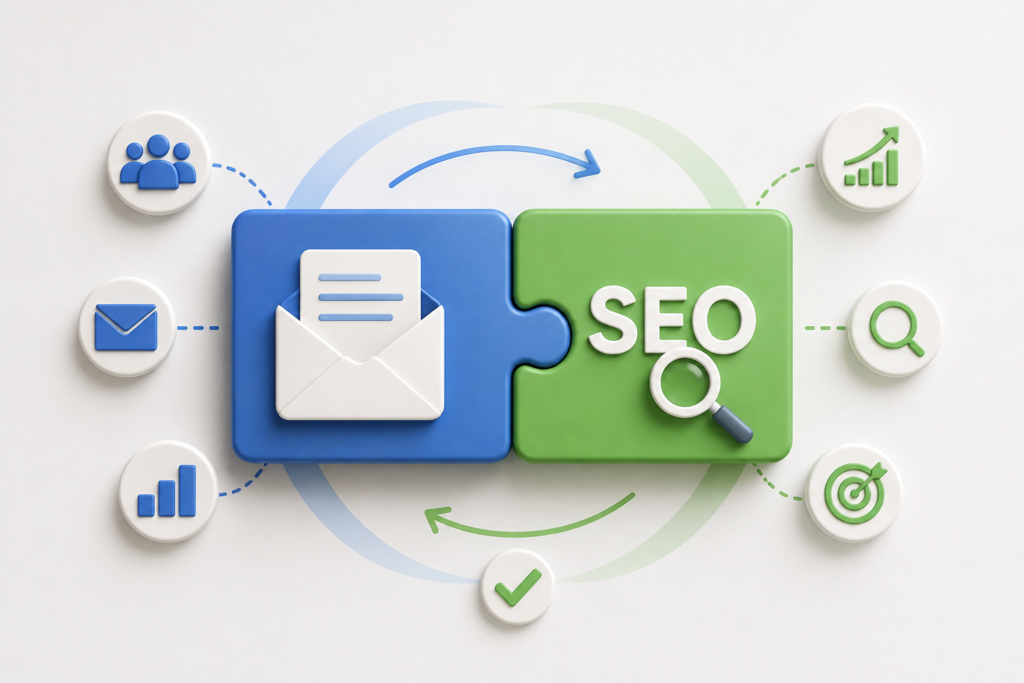
Why Email Marketing and SEO Work Better Together
SEO and email marketing have different purposes, but they can work together as part of a connected digital marketing strategy.
SEO helps businesses understand what people are searching for and create content around those topics. Email marketing then provides a direct way to distribute that content to people who have already shown interest.
This is why businesses should understand email marketing and organic traffic as complementary strategies rather than completely separate channels.
SEO Helps You
- Discover what people are searching for.
- Attract new audiences.
- Build organic visibility.
Email Marketing Helps You
- Distribute content directly.
- Bring existing audiences back to your website.
- Promote your best resources.
The Content Cycle
SEO Research
↓
Create Valuable Content
↓
Promote Through Email
↓
Drive Relevant Visitors
↓
Encourage Sharing & Discovery
↓
Use Audience Insights
↓
Create Better Future Content
This approach helps businesses make their content work harder across multiple marketing channels.
Common Mistakes to Avoid
Although email marketing can support SEO, it should never be treated as a direct shortcut to higher Google rankings.
Businesses should focus on providing genuine value instead of simply increasing email volume or trying to generate artificial engagement.
3 Key Points
1. Don’t send irrelevant content
Sending content that doesn’t match a subscriber’s interests can reduce engagement and damage the overall quality of your email campaigns.
2. Don’t focus only on clicks
A high click-through rate isn’t enough if visitors don’t find useful information after reaching your website. Focus on relevance and the complete user experience.
3. Don’t treat email as a ranking factor
Email marketing can support content distribution and audience development, but it doesn’t directly determine where your pages appear in Google search results.
How to Measure Your Email & SEO Efforts
To understand whether your email campaigns are helping your content strategy, look beyond basic email performance and examine how subscribers interact with your website.
Tracking the right metrics can help you identify which topics work, which content deserves additional promotion, and where your audience is showing the strongest interest.
3 Key Metrics
1. Email engagement
Monitor open rates and click-through rates to understand which subjects and content attract attention.
2. Website traffic from email
Track how many visitors reach your website through email campaigns and which pages they visit. This can help you understand how effectively you increase website traffic with email marketing.
3. Content performance
Identify which blogs, guides, and resources generate the most engagement, shares, mentions, or conversions.
These insights can help you continuously improve your email marketing content strategy and your broader SEO content plan.
Conclusion
Email marketing can be a powerful supporting channel for SEO when it is used strategically. It gives businesses a direct way to distribute valuable content, reconnect with existing audiences, and learn more about what their subscribers find useful.
The most effective approach isn’t about sending more emails. It’s about sending the right content to the right audience at the right time.
The 5 Strategies to Remember
- Promote your best SEO content through email.
- Use email to drive relevant website traffic.
- Repurpose existing SEO content into email campaigns.
- Encourage content sharing and backlink opportunities.
- Segment your audience to improve relevance and engagement.
The goal of how to use email marketing for SEO isn’t to manipulate search rankings. It’s about creating valuable content, distributing it effectively, and building a stronger audience around your website.
When SEO and email marketing work together, your content has more opportunities to be discovered, consumed, shared, and remembered.
FAQs
1. How Can Email Marketing Improve SEO?
Understanding how email marketing can improve SEO starts with recognizing that email isn’t a direct Google ranking factor. Instead, it can support SEO by driving qualified visitors to your website, increasing content exposure, encouraging sharing, and creating opportunities for mentions and backlinks.
2. What Are the Best Email Marketing Hacks for SEO?
Some effective email marketing hacks for SEO include promoting new blog content, repurposing existing SEO content into newsletters, segmenting subscribers, encouraging content sharing, and distributing valuable resources through targeted campaigns.
3. Can Email Marketing Directly Improve Google Rankings?
No. Email marketing is not a direct Google ranking factor. However, it can support SEO by increasing content visibility, attracting relevant visitors, and helping valuable content reach a larger audience.
4. How Can I Boost SEO With Email Marketing?
To boost SEO with email marketing, consistently promote your best content to relevant subscribers, create targeted campaigns, encourage sharing, and use audience insights to improve your content strategy.
5. How Does Email Marketing Help Increase Website Traffic?
Businesses can increase website traffic with email marketing by including relevant links to blogs, landing pages, guides, product pages, and other useful resources in newsletters and targeted email campaigns.