
Choosing the right Google Ads bidding strategies can have a major impact on how efficiently your advertising budget is spent. Google Ads offers several automated and Smart Bidding options designed to help advertisers achieve different goals, such as generating leads, increasing sales, getting more conversions, or driving valuable traffic.
But with so many options available, one question often comes up: Which Google Ads Smart Bidding strategy is right for your campaign?
The answer depends on your campaign objective, conversion data, budget, and the results you want to achieve. In this guide, we’ll explain Smart Bidding in Google Ads, explore thebest Google Ads bidding strategy for different goals, and help you understand how Google Ads automated bidding can improve campaign performance.
What Are Google Ads Bidding Strategies?
Google Ads bidding strategies determine how Google decides when and how much to bid for your ads in an auction.
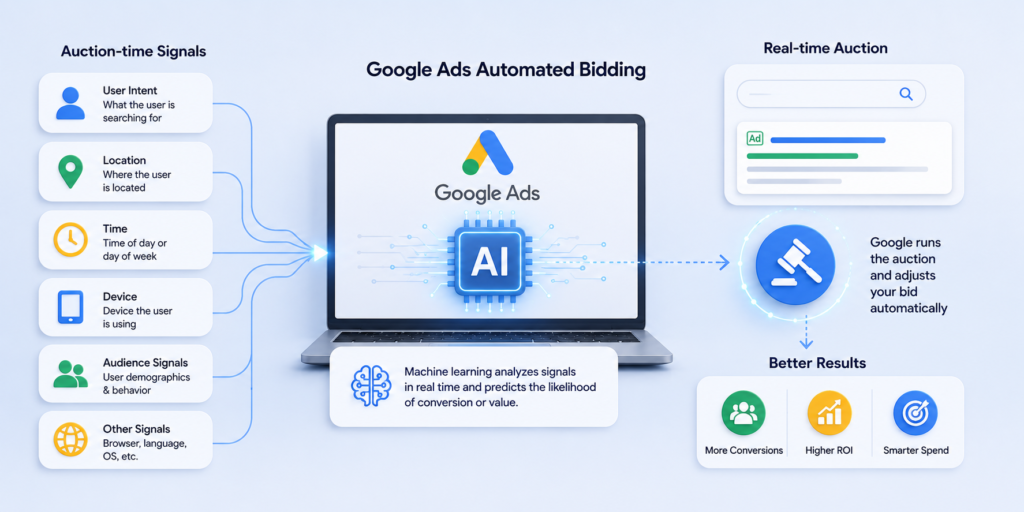
Instead of manually deciding the bid for every search, you can allow Google’s system to adjust bids based on factors such as:
- Device
- Location
- Time of day
- Search intent
- Audience signals
- Conversion probability
- Previous campaign performance
The right Google Ads campaign bidding strategy allows you to align your advertising spend with your specific marketing objective.
For example, an e-commerce business may want to maximize conversions or conversion value, while a local service business may focus primarily on generating leads.

What Is Smart Bidding in Google Ads?
Smart Bidding in Google Ads is Google’s automated bidding system that uses machine learning to optimize bids for conversions or conversion value.
Rather than using the same bid for every auction, Smart Bidding evaluates different signals and predicts the likelihood of a conversion.
Some commonly used Smart Bidding strategies include:
- Target CPA
- Target ROAS
- Maximize Conversions
- Maximize Conversion Value
This makes Smart Bidding particularly useful for advertisers who have reliable conversion tracking and enough historical data for Google’s systems to learn from.
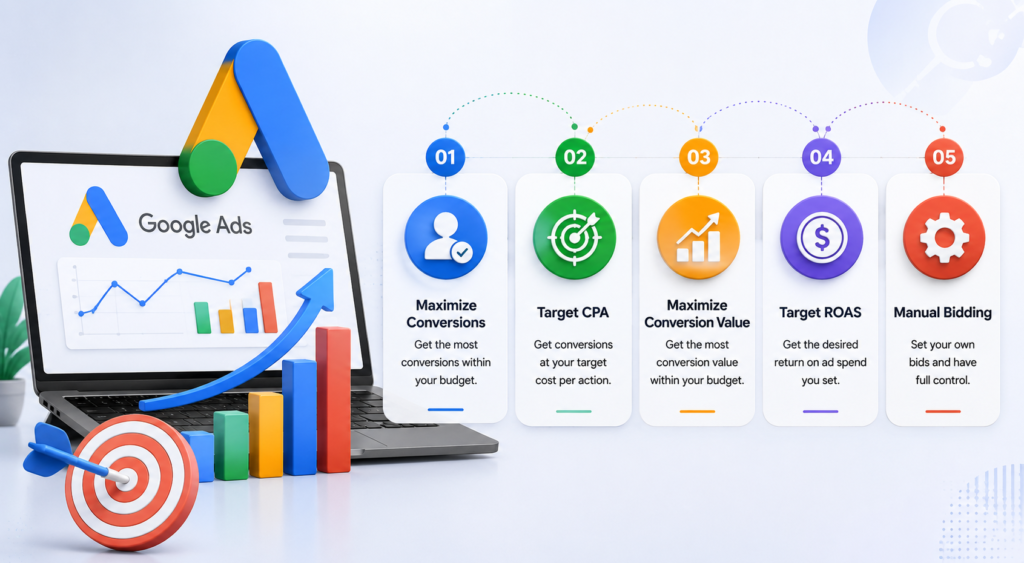
5 Google Ads Bidding Strategies You Should Know
Understanding the major Smart bidding strategies for Google Ads makes it easier to select the right approach for your campaign.
1. Maximize Conversions
If your primary goal is to generate as many conversions as possible within your budget, Maximize Conversions can be a strong option.
Google automatically adjusts bids to find users who are more likely to complete your desired conversion action.
It can be useful for:
- Lead generation campaigns
- Service businesses
- Appointment campaigns
- Businesses focused on increasing conversions
However, accurate conversion tracking is essential. If your tracking is incorrect, Google may optimize toward the wrong actions.
2. Target CPA
Target CPA allows you to tell Google approximately how much you are willing to spend, on average, to acquire a conversion.
For example, if your target cost per lead is ₹500, you can use Target CPA to help Google optimize bids toward conversions around that target.
This strategy can be suitable when:
- You have consistent conversion data.
- You understand your average acquisition cost.
- Your primary goal is lead or customer acquisition.
Keep in mind that setting an unrealistically low CPA target can restrict traffic and reduce the number of conversions.
3. Maximize Conversion Value
Not every conversion has the same business value.
For example, an e-commerce store may have one customer purchase worth ₹500 and another worth ₹5,000. Maximizing the number of conversions alone may not produce the highest revenue.
Maximize Conversion Value helps Google focus on generating greater total conversion value.
It can be useful for:
- E-commerce businesses
- Online stores
- Businesses with different order values
- Campaigns where revenue matters more than conversion volume
4. Target ROAS
Target ROAS is designed for advertisers who want to optimize toward a specific return on advertising spend.
For example, if your business wants to generate approximately ₹4 in revenue for every ₹1 spent on ads, you could set a target ROAS of 400%.
This can be an effective Google Ads automated bidding strategy when:
- Conversion values are tracked correctly.
- Your account has sufficient conversion data.
- Revenue or conversion value is important to your business.
However, an aggressive ROAS target may reduce the number of auctions Google can compete in.
5. Manual Bidding
Although automated bidding has become increasingly popular, manual bidding can still have a place in certain campaigns.
With manual bidding, advertisers have greater direct control over bids instead of allowing Google’s system to automatically adjust them.
It may be considered when:
- You need greater bid control.
- You are testing a new campaign.
- Conversion data is limited.
- You have a specific bidding strategy that requires manual management.
However, manual management can require considerably more time and ongoing optimization.
How to Choose the Best Google Ads Bidding Strategy?
There isn’t one universal best Google Ads bidding strategy for every business.
The right strategy depends primarily on your campaign objective.
If Your Goal Is More Leads
Consider:
Maximize Conversions or Target CPA
These strategies can help you focus your budget on users who are more likely to complete your lead action.
If Your Goal Is More Sales
Consider:
Maximize Conversion Value or Target ROAS
These options can be more appropriate when different conversions have different monetary values.
If Your Goal Is Conversion Volume
Maximize Conversions may be a suitable starting point when your primary objective is increasing the number of conversions.
If Your Goal Is Controlling Acquisition Cost
Target CPA can be useful when you have sufficient conversion history and a realistic acquisition-cost target.
If Your Goal Is Return on Ad Spend
Target ROAS can be considered when accurate conversion values and sufficient historical data are available.
Factors to Consider Before Choosing a Bidding Strategy
Selecting a Google Ads campaign bidding strategy shouldn’t be based only on what other advertisers are using.
Consider these factors first:
1. Campaign Objective
Start by identifying what success means for your campaign.
Is it:
- Leads?
- Sales?
- Revenue?
- Conversions?
- Website traffic?
- Brand visibility?
Your bidding strategy should support this objective.
2. Conversion Tracking
Smart Bidding depends heavily on conversion data.
Make sure important actions such as purchases, qualified leads, calls, or form submissions are being tracked correctly.
Poor conversion tracking can lead to poor optimization.
3. Historical Data
Automated strategies work better when Google has enough meaningful data to identify patterns.
A brand-new campaign with very little conversion activity may require a different approach from an established campaign with consistent results.
4. Budget
Your daily budget also matters.
If your target is too aggressive compared with your available budget and conversion volume, your campaign may struggle to generate enough traffic and conversions.
5. Conversion Value
If every conversion has approximately the same value, conversion-focused strategies may make sense.
If conversion values vary significantly, value-based bidding can be more appropriate.
How Google Ads Automated Bidding Works
Google Ads automated bidding uses machine learning and auction-time signals to adjust bids according to the likelihood of achieving your selected goal.
Google can consider signals such as:
- User device
- Location
- Time
- Browser
- Search context
- Audience characteristics
- Previous interactions
- Likelihood of conversion
This means your bid can be different for different searches based on the predicted value of each auction.
The major advantage is that advertisers don’t have to manually adjust bids for every possible situation.
Common Mistakes When Using Smart Bidding Strategies
Even the Smart bidding strategies for Google Ads require proper setup and monitoring.
Avoid these common mistakes:
Choosing a Strategy Without a Clear Goal
Don’t select a bidding strategy simply because it is popular.
First determine what you actually want to achieve.
Using Incorrect Conversion Actions
If Google is optimizing for low-quality conversions, the algorithm may find more of those conversions rather than the valuable customers you actually want.
Setting Unrealistic Targets
An extremely low Target CPA or extremely high Target ROAS may limit your campaign’s ability to participate in enough auctions.
Changing Strategies Too Frequently
Smart Bidding needs time and data to learn.
Constantly changing settings can make it difficult to evaluate performance properly.
Ignoring Conversion Quality
More conversions don’t necessarily mean better business results.
A campaign generating 100 low-quality leads may be less valuable than one generating 30 highly qualified leads.
Smart Bidding vs Manual Bidding
The biggest difference is control versus automation.
Manual bidding gives advertisers more direct control over individual bids, while Smart Bidding allows Google’s machine-learning systems to adjust bids based on auction-time signals and the campaign’s selected objective.
For many conversion-focused campaigns, automated bidding can reduce manual work and help advertisers optimize bids at scale.
However, automation doesn’t eliminate the need for strategy. Advertisers still need to manage:
- Keywords
- Search terms
- Ad copy
- Landing pages
- Conversion tracking
- Audience targeting
- Budget
- Campaign structure
How to Improve Your Smart Bidding Performance
Once you’ve selected a Google Ads bidding strategy, optimization should continue.
Here are some practical steps:
- Track the right conversions rather than every possible website action.
- Use accurate conversion values if revenue differs between conversions.
- Give the campaign enough time and data before judging performance.
- Avoid unrealistic CPA or ROAS targets.
- Review search terms regularly to identify irrelevant traffic.
- Improve landing-page experience to increase conversion rates.
- Monitor conversion quality, not just conversion volume.
- Test your strategy against your actual business objectives.
Conclusion
Choosing the right Google Ads bidding strategies starts with understanding your campaign objective.
If you want more conversions, Maximize Conversions may be a suitable option. If you have a specific acquisition-cost target, Target CPA can help you work toward that goal. For e-commerce campaigns where revenue matters, Maximize Conversion Value or Target ROAS may be more appropriate.
The key is not simply choosing the most advanced nversion data, budget, business goals, and campaign maturity.
When properly configured, Smart Bidding in Google Ads can help automate bid optimization while allowing you to focus more on campaign strategy, creative, targeting, and overall performance.
FAQS
1. What is the best Google Ads bidding strategy?
There is no single best Google Ads bidding strategy for every campaign. The right option depends on your objective, conversion data, budget, and whether you want to optimize for conversions, conversion value, CPA, or ROAS.
2. What is Smart Bidding in Google Ads?
Smart Bidding in Google Ads uses machine learning to automatically optimize bids for conversions or conversion value based on auction-time signals.
3. Which Google Ads bidding strategy is best for lead generation?
For many lead-generation campaigns, Maximize Conversions or Target CPA can be suitable, provided conversion tracking is accurate and sufficient data is available.
4. Is Google Ads automated bidding better than manual bidding?
Not necessarily in every situation. Google Ads automated bidding can be useful for conversion-focused campaigns because it can adjust bids based on many signals, while manual bidding provides greater direct control.
5. What is Target ROAS in Google Ads?
Target ROAS is a Smart Bidding strategy that aims to optimize campaigns toward a specified return on advertising spend. It is generally more suitable when accurate conversion values and sufficient data are available.